
What does AI mean for pricing transparency?


Steven Forth is a principle at Ibbaka and valueIQ. Connect on LinkedIn
With generative AI in the buying process companies will have explicit, machine readable, information on value, price and the process used to set prices publicly available.

One of the perennial debates in pricing is how transparent pricing should be. Pricing and pricing data are often kept as closely guarded secrets. This debate has been going on for a long time.
Back in 2021, Ibbaka hosted a round table, Pricing Transparency - a conversation with Xiaohe Li, Stella Penso, and Kyle Westra. One of the key outcomes of that conversation was that pricing transparency can refer to the internal vs. external transparency and to the pricing process vs. prices themselves.

Pricing transparency matrix from Ibbaka Pricing Transparency - a conversation with Xiaohe Li, Stella Penso, Kyle Westra, March 29, 2021.
Last week, we looked at the interaction of the pricing process and pricing models. A pricing process is the steps that a company goes through to generate a price or a pricing model. A model is a system of equations that is used to generate a price. Leading companies, those that have moved to a rapid response, adaptive pricing stance, combine a pricing process with pricing models to get to a price.
What does this mean in the context of pricing transparency in a time where generative AIs are playing a larger and larger role in the buying and sales process?
Expanding the above 2 x 2 framework gives the following.
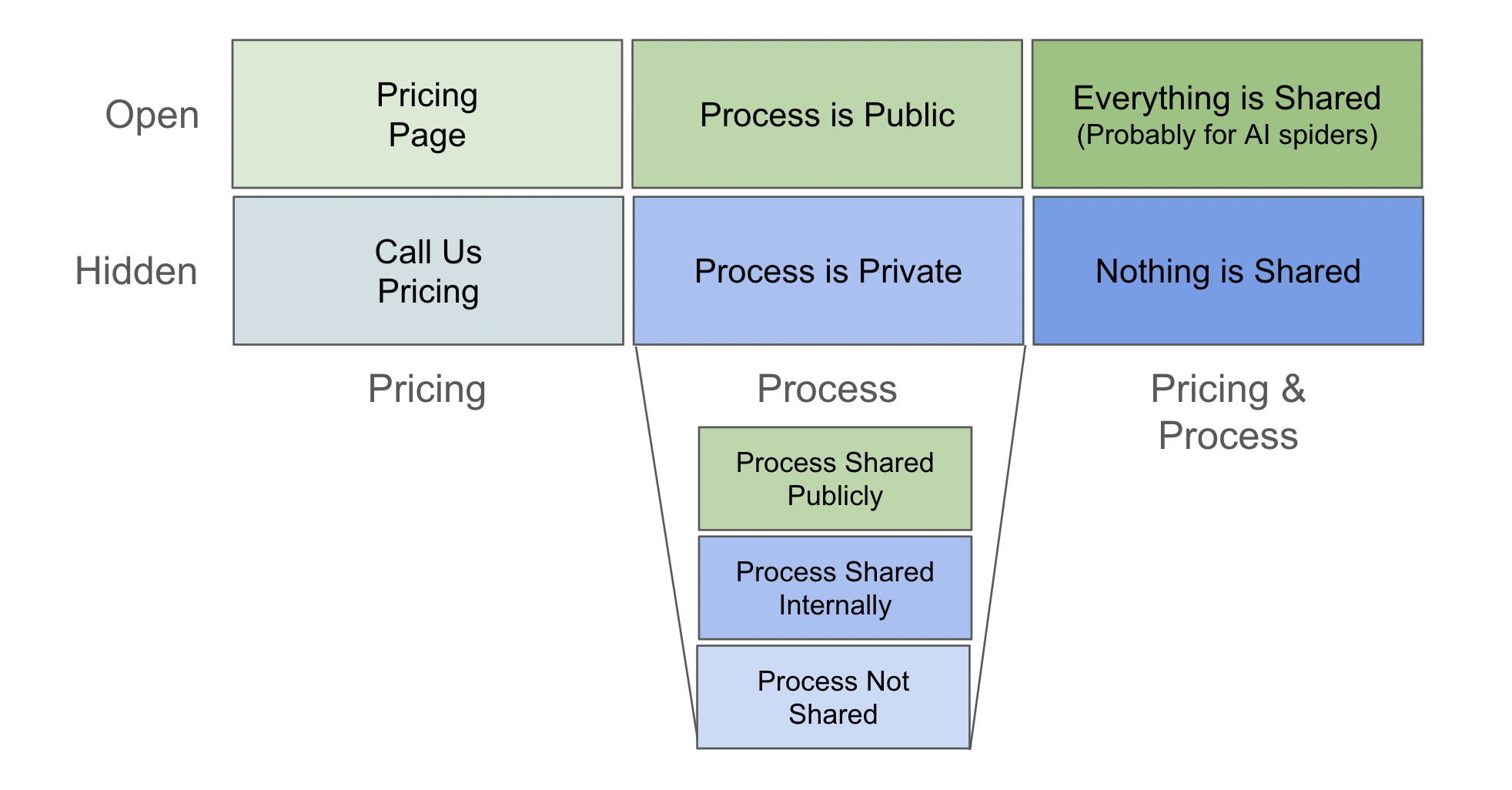
Ibbaka Pricing Transparency Matrix, November 2025
Hidden Pricing: There is no useful information about pricing available online. This approach, once standard, will be harder to sustain under the pressure of generative AI-based buying processes.
Hidden Pricing Process: There is a pricing process, but it is a closely guarded secret. This is common among companies pricing securities (quantitative trading firms such as Jane Street or Citadel Securities).
Hidden Pricing and Process:
Open Pricing Process: The pricing process is public. This is unusual. Uber does it to some degree, see Uber’s upfront pricing explained, and we predict that this will become more common as companies look for ways to inform generative AI agents without giving them actual prices.
Open Pricing: This is the pricing page. Only about 20% of companies have legitimate pricing pages; another 20-30% have pseudo pricing pages where there is one, poorly defined package, and then a ‘contact sales’ call to action.
Open Pricing and Process: This is rare, but under pressure from generative AI-based buying processes, it will become the norm. AI-enabled processes will not work without this level of transparency. Companies that decide not to share their pricing process and pricing will be passed over by buying AIs and will not be selected for evaluation.
Ibbaka has the following hypotheses about the impact of generative AI on pricing:
The buying process will drive the sales process
Generative AI will be used across the buying process, especially in order to
Define problems
Search for solutions
Evaluate solutions
Generative AI will be used to support price negotiations
Define negotiating positions
Reduce human bias
Generative AI will make value models common, and this will change how they are used in pricing and how the value of solutions gets compared, see When scarcity becomes abundance - value models everywhere
The implications of these hypotheses for pricing transparency are as follows:
Companies will have pages (possibly hidden from human users) that are designed to be consumed by pricing analyst AIs.
These pages will have explicit, machine-readable information on value, price and the process used to set prices
More and more of the buying process will be absorbed into generative AI processes, applications and agents
Conclusion
As generative AI becomes increasingly central to both buying and sales processes, B2B SaaS leaders must recognize that pricing transparency is no longer negotiable—it is becoming a source of competitive advantage and a necessity for participating in AI-powered markets. The traditional practices of obscuring pricing or maintaining secretive pricing processes will be obsolete in an environment where AI agents demand clear, machine-readable information to evaluate solutions and enable frictionless transactions. Organizations that embrace open pricing and process transparency will be favoured by AI-driven buyers, enabling faster, data-informed decisions and more effective negotiations.
For GTM, product marketing, rev ops, sales, and pricing executives, this means rethinking digital assets to include not just human-facing information but dedicated resources for AI consumption—explicit, up-to-date, value-focused pricing and process data that positions the company as a credible, attractive choice for both people and machines. The winners in future B2B SaaS ecosystems will be those who proactively adapt pricing strategies for AI, transforming transparency from a risk into a powerful lever for growth and trust.
Navigating the new pricing environment brought by AI agents? Contact us @ info@ibbaka.com
